Thanks to its thick ceramic, the kamado easily reaches 350 °C and holds that heat for a long time. With a pizza stone on top of the deflector, it recreates the conditions of a wood-fired oven: the stone sears the base while the heat from the dome puffs up the crust and melts the topping. All in three minutes.
The recipe
Kamado margherita pizza
Ingredients
The dough (4 pizzas)
- 500 g Tipo 00 flour (or strong white flour)
- 325 ml lukewarm water
- 12 g salt
- 3 g dried yeast
- 1 tablespoon olive oil
The topping
- 400 g tinned peeled tomatoes
- 2 balls of fior di latte mozzarella
- A few basil leaves
- Olive oil, salt
- Fine semolina for dusting
Equipment
- A kamado with heat deflector and pizza stone
- Lump charcoal
- A pizza peel
- An infrared thermometer (optional)
Method
- Make the dough the day before. Mix the flour and yeast, add the water, then the salt and oil. Knead for 10 minutes until smooth. Cover and leave in the fridge for 24 hours.
- Shape the dough balls. Three hours before baking, divide the dough into 4 balls of about 210 g. Leave them to rise at room temperature, covered.
- Heat the kamado. Fill the firebox well with charcoal, fit the deflector and then the pizza stone on the grill. Open the vents wide and bring it up to 350 °C. Let the stone heat for at least 30 minutes.
- Make the sauce. Crush the peeled tomatoes by hand with a pinch of salt and a drizzle of olive oil. Don’t cook it.
- Stretch the dough. On a surface dusted with semolina, stretch each ball by hand from the centre outwards, leaving a thicker rim. Avoid a rolling pin, which pushes out the air.
- Top. Place the base on the floured peel, spread 3 spoonfuls of sauce and a few pieces of well-drained mozzarella. Don’t overload it.
- Bake. Slide the pizza onto the stone, close the lid and bake for 2 to 4 minutes. Turn it half a turn halfway through for even colour.
- Serve. Add fresh basil and a drizzle of olive oil as it comes out. Wait 2 minutes for the stone to recover before the next pizza.
The secret: a long-fermented dough
Dough rested for 24 to 72 hours in the fridge develops more flavour, is easier to digest and gives a light, airy crust. Use Italian Tipo 00 flour if possible: high in protein, it copes well with high temperatures. 65 % hydration is a good balance between lightness and ease of handling.
Temperature and baking time
| Kamado temperature | Pizza style | Baking time |
|---|---|---|
| 250 to 280 °C | Thicker, home-style pizza | 7 to 10 min |
| 300 to 330 °C | Thin and crispy | 4 to 6 min |
| 350 to 400 °C | Neapolitan, puffy crust | 2 to 3 min |
Setting up your kamado for pizza
- Always use the deflector under the stone: without it, the base burns before the top is cooked.
- Place the stone as high as possible, level with the opening, to benefit from the heat reflected by the dome.
- Preheat for a long time: the lid thermometer quickly reads 350 °C, but the stone needs at least 30 minutes to get there.
- Open carefully: at high temperatures, “burp” the lid by lifting it slightly for a few seconds before opening fully, to avoid a flashback.
Topping ideas
- Prosciutto e funghi: tomato sauce, mozzarella, ham and mushrooms.
- Four cheese: mozzarella, gorgonzola, parmesan and goat’s cheese on a cream base.
- White pizza: cream, thinly sliced potatoes, bacon lardons, red onion and rosemary.
- After baking: add Parma ham, rocket, burrata or basil as it comes out of the kamado to keep them fresh.
Which kamado for pizza?
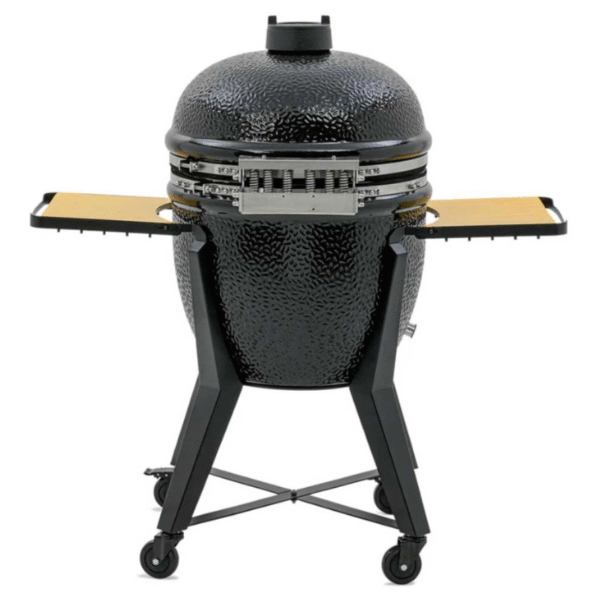
Choose a model with a grill of at least 46 cm for 30 cm pizzas. Some kamados come with their own pizza stone. See all our kamados.
-
- Sale!
Monolith TWO 55 Black Kamado with Cart, Cover and Pizza Stone
- Original price was: 2199,00 €.1979,00 €Current price is: 1979,00 €.
- View
-
- Sale!
Monolith TWO 66 black kamado with trolley, cover and pizza stone
- Original price was: 3199,00 €.2879,00 €Current price is: 2879,00 €.
- View
-
- Sale!
VESSILS FLEET GB 22 Large Kamado 49 cm BLACK
- Original price was: 1599,00 €.1299,00 €Current price is: 1299,00 €.
- View


Frequently asked questions
What temperature should I cook pizza at in a kamado?
Between 300 and 350 °C for a thin-based pizza with a puffy crust. It then takes 2 to 5 minutes depending on temperature and topping.
Do I need a pizza stone for a kamado?
Yes. Placed on the deflector, the stone stores heat and sears the base of the dough. Without it, baking is uneven.
Why does the bottom of my pizza burn?
The stone is too close to the coals or the deflector is not in place. Raise the stone and make sure there is an air gap between the deflector and the stone.